

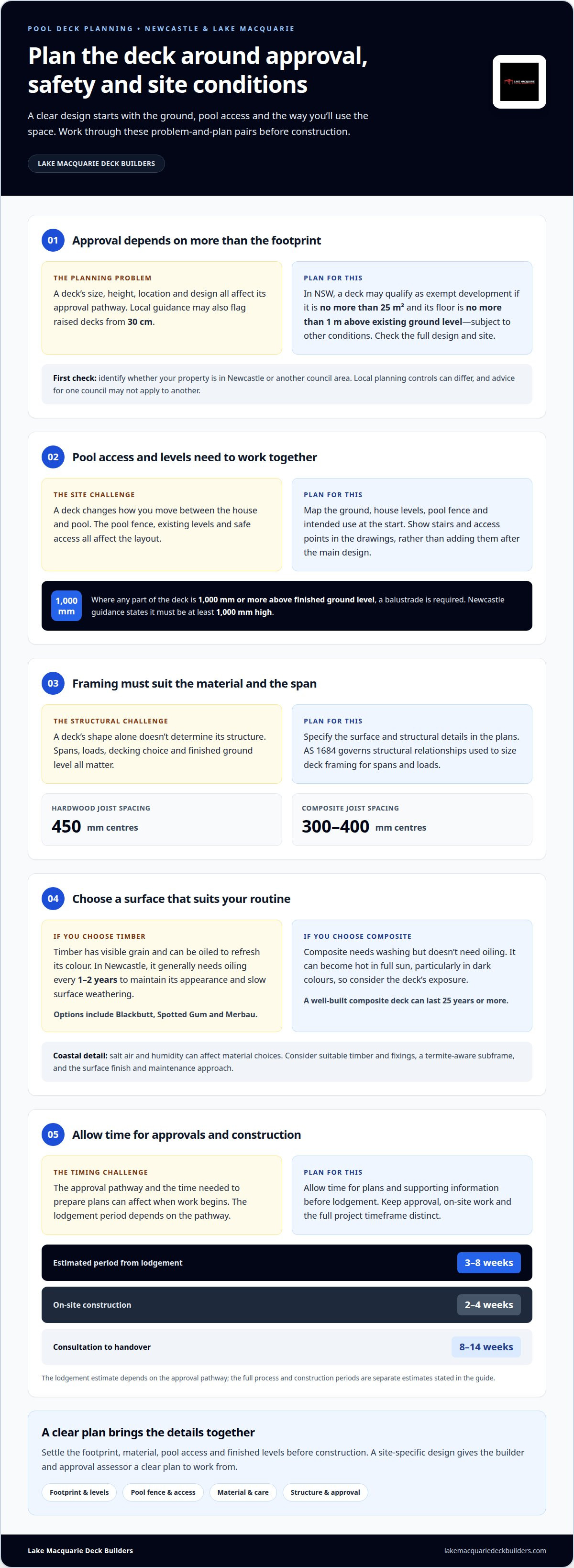
A pool deck can be built around your pool, but approval depends on its size, height and other site conditions. In NSW, a deck may qualify as exempt development if it is no more than 25 m² and its floor is no more than 1 metre above existing ground level, subject to other conditions. The layout also needs to account for the pool fence and how you’ll move safely between the house, deck and pool.
If you’re planning a family-friendly outdoor area, you’ll want clear answers before choosing a design or material. This guide covers approval considerations, compares timber and composite decking, and explains options such as Merbau, Spotted Gum and Blackbutt for Newcastle homes. It also shows how a deck builder Newcastle NSW can plan around your site, pool access and everyday use, so the finished space suits your home and routine.
Key Takeaways
- Approval depends on your deck’s dimensions, height and site conditions, so plan these details before construction.
- Compare timber’s natural look and ongoing care with composite’s simpler cleaning needs and how it can feel in full sun.
- Good structural design accounts for spans, loads and the finished ground level, not just the deck’s shape.
- Merbau, Spotted Gum and Blackbutt each bring different qualities to a deck, making timber choice part of planning for your home and routine.
Do I need planning approval for a deck in Newcastle?
Approval depends on a deck’s size, height, location and design. In NSW, it may qualify as exempt development if it is no more than 25 m² and its floor is no more than 1 metre above existing ground level, subject to other conditions. Newcastle guidance also flags raised decks from 30 cm, so check the full design and site conditions when determining the pathway.
Start with a site consultation to map the ground, house levels, pool fence and intended use. A deck builder in Newcastle NSW can use these details to shape a design and identify approval considerations before construction. The full process, from consultation to handover, typically takes 8-14 weeks; on-site construction typically takes 2-4 weeks.
Near the Newcastle coast, salt air and humidity can affect material choices. Choose suitable timber and fixings, and plan a termite-aware subframe. Spotted Gum is one option; treat all sides of its decking boards before use. Include the surface finish and maintenance approach in the design so the deck suits the site and your household routine.
Deck warranties, insurance and NSW Fair Trading protections are separate matters. Warranty terms relate to the work, while insurance responds to risks covered by the policy. NSW Fair Trading provides consumer guidance. Read the contract and insurance documents carefully to understand the terms relevant to your project.
Reviews and contact details can help you assess a builder’s work and communication. Look for examples relevant to your project, such as pool access, elevated sections or timber finishes. A deck builder in Newcastle NSW should explain the proposed scope and how the design responds to your site.
For properties in Newcastle and Lake Macquarie, make sure the proposed work suits your location and access needs. Local conditions such as slope, coastal exposure and existing structures shape the consultation, approval steps, installation and finishing plan.
Timber vs Composite Decking: Which Is Right for Your Home?
Timber offers a natural finish, while composite decking reduces some routine upkeep. Choose based on the look, care requirements and surface feel that suit your home.
Timber and composite comparisons
Timber decking has visible grain and can be oiled to refresh its colour. In Newcastle, timber generally needs oiling every 1-2 years to maintain its appearance and slow surface weathering. Composite decking needs washing but doesn’t need oiling. It can become hot in full sun, particularly in dark colours, so consider the deck’s exposure before choosing a finish.
Hardwood and composite options
Hardwood options include Blackbutt, Spotted Gum and Merbau. Each gives the deck a timber appearance, with ongoing care forming part of the choice. Composite decking offers another surface option, and a well-built composite deck can last 25 years or more. Weigh that durability against the natural variation of hardwood and the maintenance each material needs.
For a tile-ready finish, the deck structure and surface must suit the selected tiles. Plan this finish early so the design accounts for the completed surface, rather than treating tiles as a late addition. Cement-based composite decking is a separate option; compare its product specifications and intended installation with your deck’s requirements.
When comparing licensed deck builders in NSW, review the proposed scope, relevant licence details and insurance information. Ask how the design, material choice and finish will be handled, and compare written proposals on the same basis.
If composite suits your maintenance preferences, explore composite decking options as part of planning your outdoor space.
Deck design, structural specifications and council approvals
Deck dimensions, framing and location affect both construction and the approval pathway. In Newcastle and Maitland, plan the structure around your site, intended use and relevant council requirements.
Newcastle and Maitland approval considerations
First identify which council area your property is in, then match the proposed deck plans to that location. Newcastle and Maitland may have different local planning controls, so don’t assume advice for one council applies to the other. In NSW, exempt development is subject to conditions; where approval is needed, the pathway and supporting documents depend on the design and site.
Council certification guidance
Approval can follow different pathways, and the period from lodgement is estimated at 3-8 weeks, depending on the pathway. Allow time to prepare plans and supporting information before lodgement. A council or certifier can assess the proposal against applicable requirements, while construction should follow the approved design and any conditions.
Structural planning affects more than appearance. AS 1684 governs structural relationships used to size deck framing for spans and loads. Joist spacing also depends on the decking: the design specification gives 450mm centres for hardwood and 300-400mm centres for composite. A long span needs a different structural response than a short one.
Finished ground level matters for raised decks. Where any part is 1,000mm or more above finished ground level, a balustrade is required; the Newcastle guidance states that it must be at least 1,000mm high. Include the balustrade, stairs and access in the drawings, rather than adding them after the main design.
For a deck that suits your lifestyle, settle the footprint, material and access points before construction. Hardwood and composite decks may need different framing details, so the plans should specify the chosen surface. This gives the builder and approval assessor a clear design to work from, including how the deck connects to the house.
Timber species including merbau, spotted gum and blackbutt
Choosing timber for a Newcastle deck means weighing appearance, durability and ongoing care. Merbau, Spotted Gum and Blackbutt are Australian hardwood options, each with different qualities. Match the species to your home’s style and how you’ll use the finished space, rather than choosing by colour alone.
Merbau is described as naturally fire-retardant, with a low rate of expansion and shrinkage. These qualities can matter when considering how boards respond to changing conditions. Its appearance and upkeep should also suit the rest of your outdoor area. Discuss the finish during design so the timber deck complements the house.
Spotted Gum and Blackbutt, like Merbau, are hardwoods with Class 1 above-ground durability. That classification makes them useful options to consider for an exposed deck, alongside the design and maintenance plan. Look at board samples in the setting where they’ll be installed, because natural grain and colour variation affect the finished appearance.
Ironbark offers another Australian hardwood choice, with high pest resistance and fire-retardant properties. It can last 40 years in Australia if adequately maintained. That lifespan depends on care, so factor regular maintenance into your decision. A timber’s durability doesn’t remove the need to keep its surface and structure in good order.
During consultation, compare timber species against your home’s exterior, the deck’s exposure and your preferred maintenance routine. Ask how each timber’s grain, colour and finish will work with steps or adjoining outdoor areas. This helps you choose boards for the space, rather than judging a sample in isolation. A well-chosen hardwood can transform how you use your backyard.
To discuss timber choices for your project, plan a timber deck around your home and preferred finish.
Lake Macquarie Deck Builders: Timber Decks
Lake Macquarie Deck Builders can plan a timber deck around your home, site and everyday needs. Turn to the team when you’re ready to build, repair an existing deck or connect your outdoor area with a pergola.
For a new deck, start by considering how you’ll use the space and which timber suits the design. Spotted Gum and Merbau are options to weigh alongside the layout, finish and maintenance needs. If existing boards or the structure need attention, deck repairs can address the problem areas without treating every project as a new build.
Share your ideas, site conditions and preferred materials with Lake Macquarie Deck Builders to discuss a practical next step.
Take the next step towards a deck that works for you
Before choosing a design, consider the routines your outdoor space needs to support. You might want room for family meals, a clear path to the pool or a sheltered spot beside the house. Sharing these priorities with a deck builder in Newcastle NSW helps shape a plan around how you’ll use the space, not just how it looks.
Lake Macquarie Deck Builders builds and repairs decks and constructs pergolas. The team can discuss how these services fit your plans, whether you’re starting with a bare outdoor area or improving an existing deck. Your preferred timber, layout and connection to the home can guide the first conversation and help you decide what to do next.
If you’re ready to talk through your project, contact Lake Macquarie Deck Builders. A clear starting point can help turn your ideas into an outdoor space that feels at home in your everyday life.
Frequently Asked Questions
Can you build a deck around a pool?
Yes, a deck can be built around an existing pool, with the layout planned to preserve pool access and fencing. It can create a practical area for towels, seating or moving between the house and water. Share the pool position, fence and gates during planning so the deck footprint and access routes can be considered together from the start.
Can you build a deck on a sloping or elevated block?
Yes, a deck can be designed for a sloping or elevated block. The design needs to respond to changes in ground level, the deck’s height and how you’ll reach it from the house or yard. For example, a stepped layout may suit a sloping garden, while an elevated section may need planned stairs and edge protection.
How long will my new deck last?
A deck’s service life depends on its material, installation quality, exposure and ongoing maintenance. Timber needs care suited to its species and finish, while composite decking has different cleaning needs. Watch for worn surfaces, loose boards and areas where water collects. Addressing wear promptly helps you maintain the deck as it ages.
Ready To Build Your New Deck in Newcastle?
If you’re ready to plan a deck in Newcastle, Lake Macquarie Deck Builders can discuss your project. Talk about how you want to use the space, your yard’s shape and whether you’re building new or repairing an existing deck. You can also discuss how a pergola might fit your outdoor plans.
Which type of decking do you recommend for homes in Newcastle and Lake Macquarie?
No single decking material suits every home. Timber may suit you if you prefer natural grain and are comfortable with ongoing care. Composite may suit you if you prefer a different maintenance routine. Before choosing, consider how much sun the area receives, the look beside your home and the upkeep you can manage.
Why Choose Decking for Your Newcastle Property?
Decking can create a defined outdoor area for meals, quiet time or family activities. It can also make the transition between your home and yard more useful, especially where a plain patch of ground is difficult to furnish. Plan the size and access around your usual routine so the finished space works for everyday use.